
12 Energy Pathways: The Hidden Map of Emotions

Have you ever noticed how emotions seem to have a physical location? Anxiety can feel like butterflies in the stomach. Grief can make the chest feel heavy. Anger may tighten the shoulders and jaw. Fear can make the entire body tense.
Long before modern neuroscience began exploring the connection between the brain and body, ancient healing traditions developed their own ways of understanding this relationship. One fascinating perspective is the connection between emotions and energy pathways.
An Ancient Map of Body and Mind
In ancient China, pathways are described as routes through which Qi, or vital energy, moves throughout the body. Rather than viewing the mind and body as completely separate systems, it is believed that physical state, emotional experience, environment, and lifestyle are interconnected.
Popular interpretations of this tradition associate the twelve principal energy pathways with different emotional tendencies. Below is one of the commonly shared version of this map:
| Energy Pathways | Positive Emotional Association | Negative Emotional Association |
|---|---|---|
| Gallbladder | Courage, confidence, decisiveness | Hesitation, indecision, timidity |
| Liver | Creativity, flexibility, emotional balance | Anger, frustration, tension |
| Lung | Inspiration, acceptance, letting go | Sadness, grief, emotional heaviness |
| Large Intestine | Release, clarity, renewal | Attachment, regret, difficulty letting go |
| Stomach | Stability, grounding, nourishment | Impatience, restlessness, overthinking |
| Spleen | Trust, calmness, centeredness | Worry, excessive thinking, feeling burdened |
| Heart | Joy, connection, compassion | Inner unrest and emotional disturbance |
| Small Intestine | Discernment, understanding, empathy | Sorrow and confusion |
| Bladder | Resilience and adaptability | Negativity and emotional distress |
| Kidney | Wisdom, inner strength, confidence | Fear, insecurity |
| Pericardium | Openness, connection, emotional elevation | Emotional guardedness, suppression |
| Triple Burner | Harmony, adaptability, relaxation | Stress, tension, imbalance |
This pathway–emotion map becomes especially interesting when we stop viewing it as a diagnostic chart and instead use it as a prompt for self-awareness.
Feeling overwhelmed? Notice whether you have been moving, resting, eating, and sleeping differently.
Feeling emotionally “stuck”? Rather than immediately trying to suppress the feeling, take a moment to observe how it shows up in your body.
This kind of awareness does not require believing that one specific emotion belongs to one specific system. It simply invites us to recognize that emotions can have a physical dimension. Sometimes, simply noticing these connections creates a moment of awareness and gives us space to slow down.
Same Conversation, Different Languages
Modern physiology does not explain emotions through energy pathways. Instead, it explores how emotions and stress interact with the body through the brain–body communication networks.
When we experience stress, for example, the sympathetic nervous system activates the familiar “fight-or-flight” response. Heart rate and breathing may increase, muscles tense, digestion changes, and hormones such as adrenaline and cortisol are released. When the stressful time passes, the parasympathetic nervous system helps guide the body back to its "rest-and-digest" state.
The state of our body also continuously sends signals back to the brain, influencing how we feel and respond to the world around us. For example, prolonged muscle tension, disrupted sleep, changes in breathing patterns, or ongoing stress responses may affect our mood, focus, and sense of well-being. In this way, our physical state and emotional state are constantly communicating.
The vocabulary may be different from that used in ancient holistic traditions, but the broader observation is surprisingly familiar: the mind and body are in an ongoing conversation.
Bringing Support into Your Routine
Aha Halo introduces a modern way to explore wellness support through scalar energy and frequency technology. It is designed to be your helpful wellness companion that accompanies you through different moments. (For more real-user testimonials, please read here)
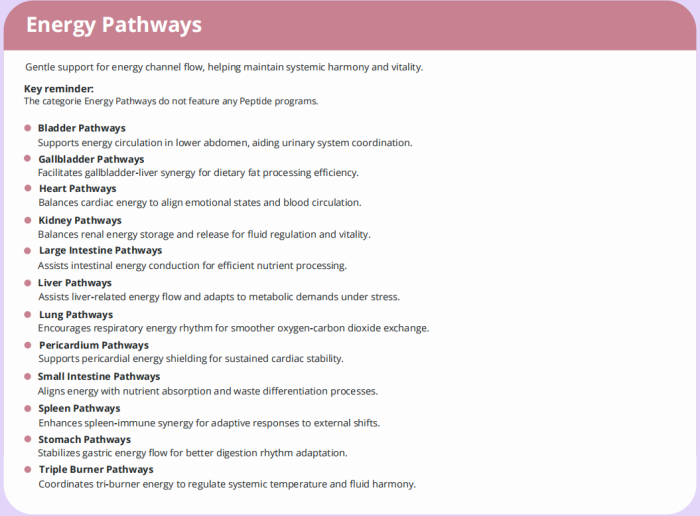
The Energy Pathways collection in the program library offers a series of frequency programs inspired by traditional pathway concepts, covering all twelve major energy pathways. For optimal experience, it is recommended to run corresponding pathway programs according to the Meridian Clock, a traditional framework that maps different pathways to specific times throughout the day. (For more information, please check this blog) Alternatively, you can explore these programs in harmony with your own routines.
Rather than viewing energy pathways as something to diagnose or fix, Aha Halo invites you to approach them as an opportunity to slow down, listen inward, and create intentional moments of connection between your body and mind.
