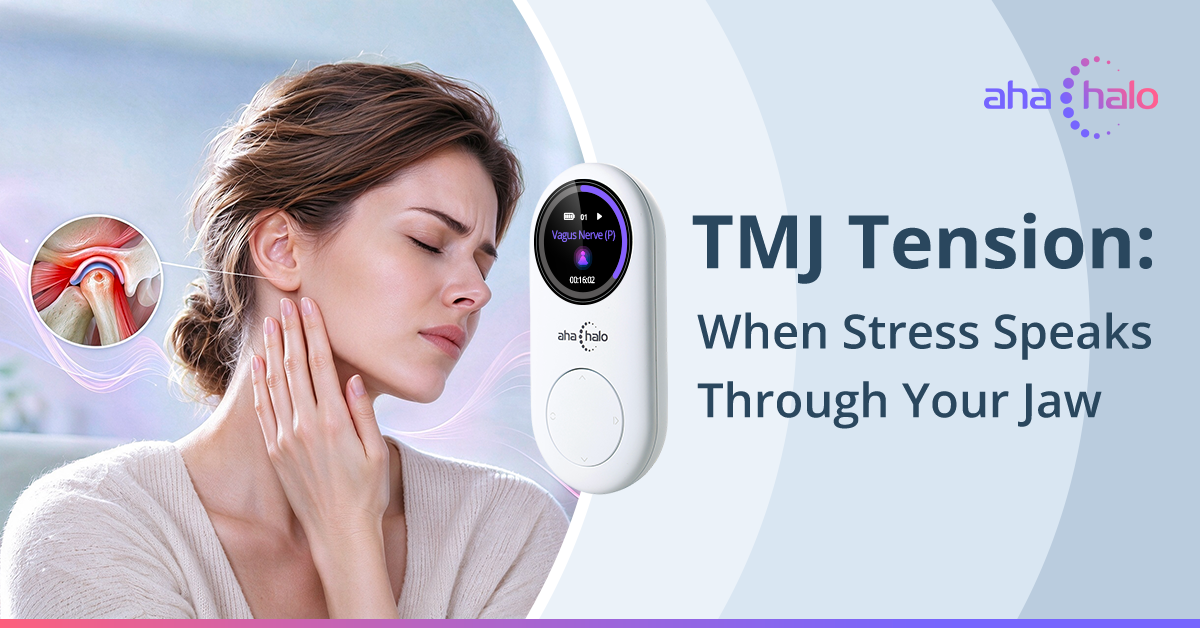
TMJ Tension: When Stress Speaks Through Your Jaw
Have you ever noticed yourself clenching your jaw during stressful moments?
Stress can show up physically in subtle ways. But did you that your jaw can also hold stress? The temporomandibular joint (TMJ), which connects the lower jaw to the skull, plays a central role in jaw movement. Because of the close, complex interaction between the mind and body, jaw tension can sometimes be an indicator of unreleased stress.
In this article, we’ll explore the connection between stress and jaw tension around the TMJ, and what we can do to support greater relaxation and mind-body balance, starting with this little joint.
When Stress Shows Up in Your Jaw
Stress does not always appear in dramatic ways. Sometimes, the body becomes the first place where stress manifests itself. During periods of stress, some people may develop or notice unconscious jaw-clenching habits, such as:
- Tightening the jaw while concentrating
- Pressing the teeth together without noticing
- Holding tension around the face and neck
- Clenching during sleep
Over time, these patterns can leave the jaw feeling tired, tight, or uncomfortable. Below are some signs that you may be holding tension around your jaw area. Recognizing them can be an important first step toward greater body awareness:
- Jaw Tightness or Fatigue
After a long day of focusing or dealing with pressure, you may notice that your jaw feels more tense than usual or takes more effort to relax. This can be a sign that the muscles around the TMJ have been working harder than usual. - Facial and Neck Tension
The jaw works closely with surrounding muscles in the face, neck, and shoulders. If you notice tension building in these areas, it may also be worth checking whether you are unconsciously clenching your jaw. - Waking Up Still Tired
Jaw tension does not always stop when you fall asleep. If the body remains in a heightened state of alertness, it may be harder to fully settle into restful sleep. You may wake up feeling less refreshed and, in some cases, notice tightness or soreness around the jaw.
Why Stress Often Shows Up in the Jaw
The body responds to stress through a complex connection between the nervous system, muscles, and connective tissues. When we experience pressure, the body naturally prepares for action by increasing muscle activity and alertness.
The jaw is one area that can reflect this response. When stress continues over time, the body may remain in a more activated state, influencing breathing patterns, muscle tone, and the ability to fully relax.
The jaw is also part of a larger network of muscles and connective tissues, including the fascia, that extends through areas around the jaw, temples, neck, and upper shoulders. This interconnected network means tension around the TMJ may sometimes be part of a broader pattern of tightness.
So, easing jaw tension is not simply about remembering to unclench. The key is to support greater relaxation and overall mind-body balance.
Simple Ways to Support Jaw Relaxation
Practice Tension Awareness
Pause occasionally and check in with yourself: Is my jaw relaxed? Am I clenching my teeth? Does my face or shoulders feel more tense than usual? Simply noticing these patterns can help you catch unconscious tension early and consciously let it go before it builds up.
Pay Attention to How You Chew
Jaw tension can also be influenced by chewing habits, such as chewing mostly on one side or frequently chewing gum. An uneven bite may also affect how pressure is distributed around the jaw. Becoming aware of these patterns can help you identify habits that may be adding extra strain, while concerns about your bite are best discussed with a dental professional.
Take Movement Breaks
Gentle movement, especially around the neck, shoulders, and upper body, can help break up tension that builds from prolonged sitting or repetitive daily habits. If you notice that you’ve been clenching your jaw for a while, try gently opening and closing your mouth a few times within a comfortable range. This simple reset may help relax the muscles around the jaw and TMJ area.
Support Mind-Body Balance with Aha Halo
Easing jaw tension is often about giving your body more chances to slow down and relax. Aha Halo can fit naturally into those everyday moments, creating a restorative scalar field while supporting your mind-body balance. Paired with thoughtfully created frequency programs, it can bring an extra layer of support to your relaxation routine:
- Vagus Nerve (P)
The vagus nerve is closely connected with the body’s relaxation response and mind-body communication. As a much-loved program in our community (read more here), Vagus Nerve (P) supports gentle relaxation, emotional ease, and whole-body harmony. - Relaxation (P)
Sometimes, the simplest thing your body needs is a chance to slow down. Relaxation (P) offers gentle support for daily tension, helping guide the body and mind toward a calmer, more relaxed state. - Fascial Support (P)
TMJ tension is not always just about the jaw. Within the body’s interconnected fascial network, tightness around the jaw can sometimes be part of a wider tension pattern. Fascial Support (P) supports fascial flexibility and helps ease these patterns, promoting smoother movement and greater daily comfort.
Want to experience Aha Halo for yourself and bring more comfort and balance to those moments when stress speaks through your jaw? Follow the link below and discover a new companion for your wellness routine.
I am a dentist and have sen lots of TMJ problems, I also recommend cortisol balance.
Hi! Thank you for sharing your perspective and for taking the time to comment. 😊 We really appreciate hearing from community members with professional experience, and we’re glad you shared Cortisol Balance (P) as a program you recommend exploring.
Thank you again for contributing to the conversation and sharing your experience with the Aha Harmony community! 💜