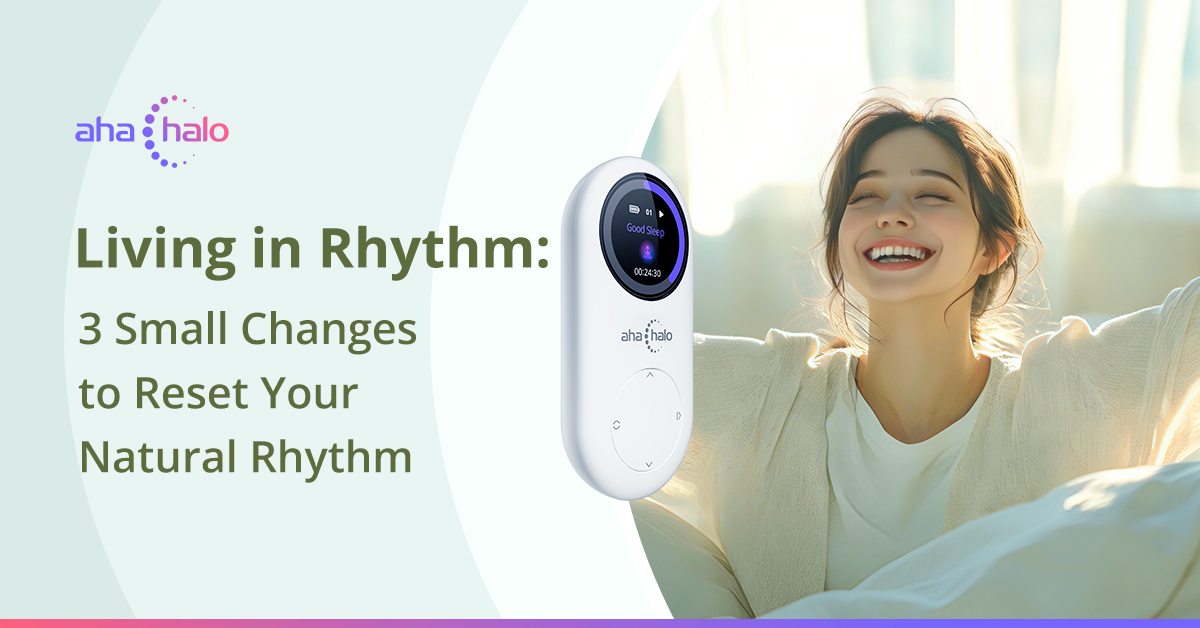
Living in Rhythm: 3 Small Changes to Reset Your Natural Rhythm
Have you ever done this? You scroll past a “disciplined morning routine” vlog, feel a surge of motivation, and decide you’re finally going to change your life. The next morning, the 6 a.m. alarm goes off. You spring out of bed, splash cold water on your face, roll out the yoga mat. In that moment, it honestly feels like a new version of you has arrived. Then day three comes. The alarm rings, you hit snooze, and wake up at nine. The routine falls apart. You feel foggy all day. That night, lying in bed, the self-doubt creeps in: Why can’t I even stick to something this simple?
The problem isn’t you. It’s the way we think about “discipline.” Real rhythmic living isn’t about forcing your body to comply — that rarely lasts. It’s about small, steady shifts that work with your natural timing instead of against it.
So instead of rigid schedules or extreme routines, we’ll focus on three simple adjustments. Each one aligns with a rhythm you’re already connected to: the pineal gland, the Schumann resonance, and alpha waves.
Wake Up to Light, Not an Alarm
Being jolted awake by a loud alarm isn’t just unpleasant. It pushes your body from deep rest into full alert in seconds. Heart rate rises, stress hormones increase, and the day starts in a rush.
The pineal gland helps regulate your internal rhythm. Light encourages wakefulness, while darkness allows melatonin to rise. If you want a smoother start, begin with light.
Small Shift 1: Spend One Minute with Light
When you wake up, don’t reach for your phone immediately. Sit up and look toward the window (without staring directly at the sun). Let natural light reach your eyes for about a minute. It’s a simple cue that helps your internal clock transition into the day.
You might be wondering: What if there’s no morning light in my room, or it’s still dark when I wake up?
In that case, Aha Halo can help. Run the Pineal Gland program as you wake to gently signal that the day has begun. It’s not an alarm, but a frequency tool that supports your natural rhythm. Waking up can feel steadier, not stressful.
Carry the Earth’s Pulse with You
Have you ever noticed that after spending too long inside tall buildings, you start to feel slightly on edge or disconnected? Then you take a walk in the park, or lie down on the grass somewhere quiet, and that unsettled feeling fades.
That shift isn’t just psychological.
The Earth has a natural electromagnetic frequency of 7.83 Hz, known as the Schumann resonance. Humans evolved within this steady background field.
Modern life, however, keeps us separated from it. Concrete buildings, rubber-soled shoes, and constant electronic signals create distance between us and the Earth’s natural field.
If you want to reconnect, start simply.
Small Shift 2: Go Barefoot When You Can
If you have access to grass, soil, or sand, take off your shoes and stand barefoot for five minutes. It’s a direct way to reconnect with the ground beneath you.
And if going barefoot isn’t practical, there’s another option.
You can run the 7.83 Hz Schumann Resonance program. This frequency mirrors the Earth’s natural background rhythm. Used as a subtle background support, it helps recreate a sense of grounding — even indoors.
Let Your Brain Go Offline
Most of us rarely stop. Podcasts during the commute. Videos while cooking. Scrolling before bed. From morning to night, the brain stays in a high-alert beta state. Just above that sits anxiety.
But the brain isn’t meant to stay switched on all the time. It needs moments with no input — no noise, no content, no task.
Alpha waves are associated with relaxed, wakeful states. It’s the kind of state you slip into when you’re staring at the sky or letting your thoughts drift. It’s also when the brain resets and rebalances.
Small Shift 3: Create One Phone-Free Moment
Start with something simple. Take a shower without bringing your phone into the bathroom. Don’t fill the silence. Just notice the sensation of warm water on your skin — the temperature, the pressure, the steam.
If your thoughts wander, gently bring your attention back. Nothing more.
If even that feels difficult, you can run the Alpha Waves program softly in the background. It supports a calmer brain rhythm, making it easier to settle without trying so hard.
Living with Rhythm, Not Against It
These three shifts are really an invitation to live a little differently. Instead of pushing through each day on willpower alone, you begin to work with your body’s timing — giving yourself a gentle nudge rather than forcing change.
You may notice that when you wake with light, steady yourself with the Earth’s rhythm, and allow your mind to drift now and then, the things that once felt like discipline start to feel more natural. Not because you’re trying harder, but because you’re aligning with patterns your body already understands. You’re simply learning to trust them again.
Rhythmic living isn’t about becoming a better version of yourself. It’s about becoming yourself with more ease. You can begin tonight. Or in the next quiet moment you choose to pause.