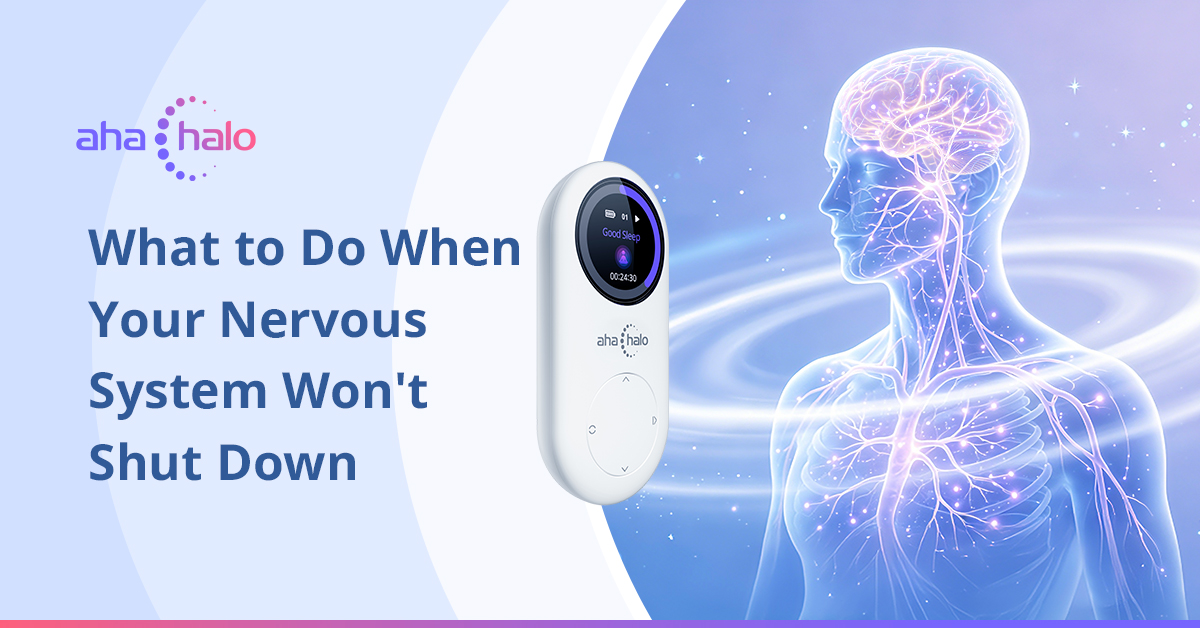
What to Do When Your Nervous System Won’t Shut Down
We’ve all been there: the laptop is closed, the lights are dim, and you finally have some time to unwind. Yet, underneath the surface, your heart is racing, your mind is looping, and you still feel like engaging in a non-existent battle. You try to rest, but your nervous system simply refuses to stand down.
While this prolonged state of alertness is deeply frustrating, it isn't permanent. Aha Halo is designed to help your body find the "off" switch and shift into a state of calm and serenity.
Why You Are Stuck in High Alertness
The reason why we can’t relax lies in the modern environment we live in. Evolutionarily, our fight-or-flight response was designed for short bursts of life-saving energy. In today's world, this system is being continuously hijacked by non-stop micro-stressors.
Information Overload: We consume more information in a single day than our ancestors did in a lifetime. Every ping is a tiny spike of cortisol, and every new notification adds to the mental clutter.
The Blue Light Trap: Constant screen exposure tells your brain it’s high noon even at 11pm, suppressing the melatonin needed for deep rest and recovery.
The "Fast" Culture: Modern culture tends to equate stillness with laziness, constantly pushing us to do more. This mental pressure keeps the body trapped in a perpetual fight-or-flight state.
Shallow Breathing: Under stress, we naturally shift to shallow chest breathing. This limits our oxygen intake and signals to the brain that we are in danger, trapping us in a feedback loop of physical tension.
When these factors combine, the internal "brake" of your nervous system—your vagus nerve—gets suppressed. Your system simply "forgets" how to transition back into a restful state.
Breaking the Cycle: Practical First Steps
Shifting out of a chronic alert state requires signaling safety to your body through your environment and your small actions.
The 4-7-8 Breath: Inhale for 4 seconds, hold for 7, and exhale slowly for 8. The long, deep breath activates the parasympathetic response, forcing the vagus nerve to engage and slowing down your heart rate.
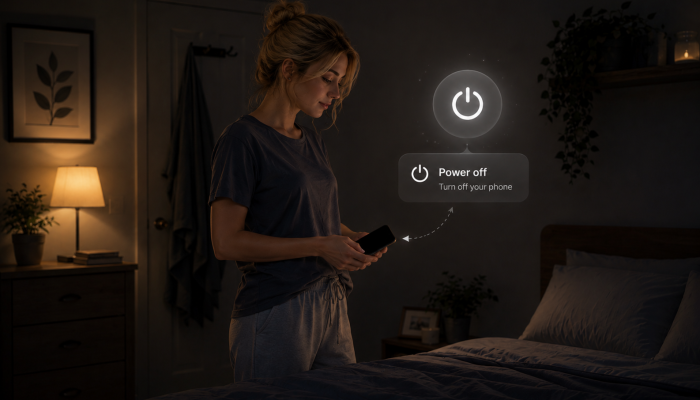
Digital Sunset: Create a "zero-stimulus" window at least 60 minutes before bed. Turn off all screens and remove EMF sources. Swap scrolling for a physical book or a brief mindfulness session.
Sensory Reduction: Although we may not feel it, our brains are constantly processing noise and light. Creating a comfy, dark and quiet "sanctuary" can help reduce the cognitive load on your sensory system.
Aha Halo for Smoother Transition
While lifestyle changes are foundational, sometimes a hyper-vigilant nervous system needs a bit more "nudge" to recalibrate. This is where Aha Halo's scalar field technology becomes a game-changer.
When your nervous system is trapped in chronic stress and over-stimulation, Aha Halo’s scalar field technology can help break this status by introducing subtle, longitudinal waves that create a deeply calming, high-energy environment. Unlike traditional electromagnetic fields that can add to environmental stress, scalar fields work at a cellular level, helping to optimize cell membrane potential and enhance cellular resonance.
This stabilizing energy acts as an anchor for a hyper-vigilant body, gently coaxing your brainwaves out of high-stress states and into the relaxing rhythms. This shift effectively flips your internal "off" switch, allowing your body to drop out of survival mode and enter the deep, restorative state necessary for true recovery.
To maximize the calming effect of your Aha Halo, we recommend these expertly engineered frequency programs to help your nervous system smoothly transition into relaxation:
Vagus Nerve (P): This is the essential program for anyone feeling hyper-vigilant. It stimulates the parasympathetic pathway, encouraging deeper relaxation, emotional ease, and whole-body harmony.
Relaxation (P): A foundational program that helps release your mental and physical tension for better resillience.
Alpha Waves: Alpha wave stimulation encourages relaxed yet alert mental states for daily cognitive balance. You can use Alpha Waves during work breaks or in the early evening to bridge the gap between work and rest.
Delta Waves: This program supports deep relaxation and restful states. When it’s time for sleep, shifting to Delta Waves encourages the deep, slow-wave state necessary for actual recovery and restoration.
Build Your Relaxation Routine Today
You don’t have to stay stuck in this high alertness. With the power of Aha Halo and a better understanding of this state, you can easily flip the switch and embrace deep, restorative rest.
For more tips and real-life inspiration, join our Aha Halo FB community today and connect with like-minded fellow users to unlock more healing potentials.
Hi there, I have had an aha halo since January 2026 and have found it life changing my sleep patterns are better I feel much more rested and restored each day.
Thank you so much for sharing your experience! 💜😊 We’re delighted to hear that your Aha Halo has been such a positive part of your wellness journey.